- Sarjana Muda Teknologi Kejuruteraan Pembuatan (Rekabentuk Automotif)
- PEO\PLO
- Prospek Kerjaya
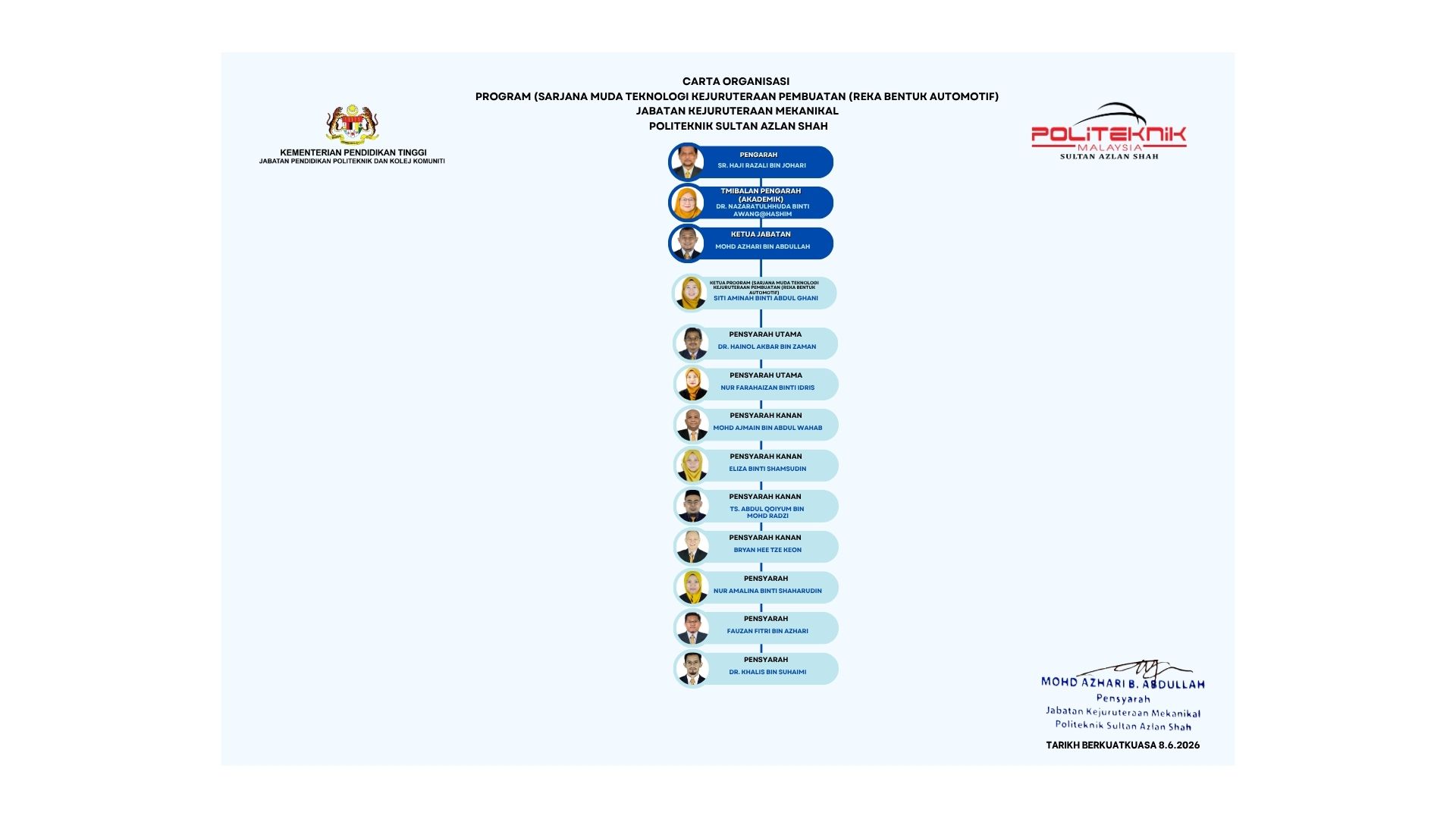
- Carta Organisasi
Program Sarjana Muda Teknologi Kejuruteraan Pembuatan (Rekabentuk Automotif) dengan Kepujian yang ditawarkan di Politeknik Sultan Azlan Shah (PSAS) telah dibangunkan untuk mengisi keperluan tenaga kerja dalam sebahagian ruang lingkup bidang kejuruteraan pembuatan yang sangat luas. Program yang berasaskan Workbase Learning (WBL) ini menyediakan pengetahuan dan kemahiran yang khusus dalam bidang rekabentuk automotif dan kejuruteraan pembuatan yang boleh diaplikasi untuk pelbagai kerjaya dalam industry automotif masa kini. Pelajar akan lebih banyak didedahkan dengan pelbagai elemen inovatif melalui silibus dan kurikulum yang lebih memfokuskan kepada proses rekabentuk komponen asas automotif yang seterusnya membawa kepada rekabentuk pembuatan enjin serta rekabentuk badan kenderaan keseluruhannya.
Antara modul pengajian yang ditawarkan di dalam program ini adalah RekaBentuk Automotif, Sistem Automotif, Peraturandan Undang-undang Automotif, Teknologi Hijau Automotif, Analisis Unsur Tak Terhingga dan Sistem Pengurusan Pengeluaran. Pengetahuan dan kemahiran yang diperoleh oleh pelajar daripada program ini akan membolehkan mereka menyahut cabaran dalam pasaran kerja yang sangat mencabar pada masa kini lebih-lebihlagi dalam bidang automotif. Justeru, program ini sangat signifikan untuk melahirkan tenaga kerja profesional yang kompeten dan mampu membangunkan rekabentuk yang baru atau menambah baik struktur mesin, enjin, transmisi, atau sistem kenderaan lain yang sedia ada dengan menggunakan teknologi terkini serta dibantu dengan perisian rekabentuk komputer yang terkini.
Tempoh Pengajian – 3 Tahun (PSAS) + 1 Tahun (Industri)
Curriculum 2025 PEOs
PEO1: | be proficient with industry-relevant knowledge and skills in manufacturing engineering field |
PEO2: | engage on lifelong and continuous learning to enhance knowledge and skills |
PEO3: | apply entrepreneurial skills and mind set in the real working environment |
PEO4: | engage with society and players in the industry |
PROGRAMME LEARNING OUTCOMES (PLO)
Upon completion of the programme, graduates will be able to:
PLO1: | Apply knowledge of mathematics, natural science, manufacturing engineering technology and automotive design as specified in SK1 to SK4 respectively to defined and applied engineering procedures, processes, systems or methodologies. |
PLO2: | Identify, formulate, research literature and analyse broadly-defined engineering problems reaching substantiated conclusions using analytical tools appropriate to manufacturing engineering or automotive design discipline; with considerations for sustainable development. (SK1 to SK4). |
PLO3: | Design solutions for broadly-defined engineering problems and contribute to the design of systems, components or processes to meet specified needs with appropriate consideration for public health and safety, whole-life cost, net zero carbon as well as resource, cultural, societal, and environmental considerations as required. (SK5). |
PLO4: | Conduct investigations of broadly-defined engineering problems; locate, search and select relevant data from codes, data bases and literature, design and conduct experiments to provide valid conclusions. (SK8). |
PLO5: | Select and apply, and recognize limitations of appropriate techniques, resources, and modern engineering and IT tools, including prediction and modelling, to broadly-defined engineering problems. (SK2 and SK6). |
PLO6: | Analyze and evaluate sustainable development impacts to: society, the economy, sustainability, health and safety, legal frameworks, and the environment, in solving broadly-defined engineering problems. (SK1, SK5 and SK7). |
PLO7: | Understand and commit to professional ethics and responsibilities and norms of engineering technology practice and adhere to relevant national and international laws. Demonstrate an understanding of the need for diversity and inclusion. (SK9). |
PLO8: | Function effectively as an individual, and as a member or leader in diverse and inclusive teams and in multi-disciplinary, face-to-face, remote and distributed settings. (SK9). |
PLO9: | Communicate effectively and inclusively on broadly-defined engineering activities with the engineering community and with society at large, by being able to comprehend and write effective reports and design documentation, make effective presentations, taking into account cultural, language, and learning differences. |
PLO10: | Apply knowledge and understanding of engineering management principles and economic decision making to one's own work, as a member and leader in a team and to manage projects in multidisciplinary environments. |
PLO11: | Recognise the need for, and have the ability for i) independent and life-long learning and ii) critical thinking in the face of specialised technical knowledge. (SK8). |
Curriculum 2020 PEOs
PEO1: | Ready with industry-relevant knowledge and skills in Manufacturing Engineering Field |
PEO2: | Engaging on lifelong and continuous learning to enhance knowledge and skills |
PEO3: | Apply with entrepreneurial skills and mind set in real work |
PEO4: | Established strong linkage with society and players in the industry |
PROGRAMME LEARNING OUTCOMES (PLO)
Upon completion of the programme, graduates will be able to:
PLO1: | Apply knowledge of mathematics, science, manufacturing engineering fundamentals and automotive design to defined and applied engineering procedures, processes, systems or methodologies |
PLO2: | Identify, formulate, research literature and analyse broadly-defined engineering problems reaching substantiated conclusions using analytical tools appropriate to manufacturing engineering or automotive design discipline |
PLO3: | Design solutions for broadly-defined engineering problems and contribute to the design of systems, components or processes to meet specified needs with appropriate consideration for public health and safety, cultural, societal, and environmental considerations |
PLO4: | Conduct investigations of broadly-defined problems; locate, search and select relevant data from codes, data bases and literature, design and conduct experiments to provide valid conclusions |
PLO5: | Select and apply appropriate techniques, resources, and modern engineering and IT tools, including prediction and modelling, to broadly-defined engineering activities, with an understanding of the limitations |
PLO6: | Demonstrate understanding of the societal, health, safety, legal and cultural issues and the consequent responsibilities relevant to engineering technology practice |
PLO7: | Understand the impact of engineering technology solutions in societal and environmental context and demonstrate knowledge of and need for sustainable development |
PLO8: | Understand and commit to professional ethics and responsibilities and norms of engineering technology practice |
PLO9: | Function effectively as an individual, and as a member or leader in diverse technical teams |
PLO10: | Communicate effectively on broadly-defined engineering activities with the engineering community and with society at large, by being able to comprehend and write effective reports and design documentation, make effective presentations, and give and receive clear instructions |
PLO11: | Demonstrate knowledge and understanding of engineering management principles and apply these to one's own work, as a member and leader in a team and to manage projects in multidisciplinary environments |
PLO12: | Recognize the need for, and have the ability to engage in independent and life-long learning in specialist technologies |
• Automotive design technologist
• Manufacturing technologist
• R&D technologist
• Quality Technologist
• Project Executive
• CAD/CAE technologist
• Production planning and control
executive